Tuesday, 20 November 2012

M-pen land dispute case


In the last few days, the situation in M-pen village at Miao circle in Changlang district of Aruanachal Pradesh has been tense ahead of the hearing scheduled at Itanagar Permanent Bench of the Guwahati High Court on 21 November 2012. The Court will hear the M-pen land dispute case between the Chakma and Singpho communities. Earlier last month, the hearing was postponed, but the Court directed the district administration not take any coercive measures against the petitioners (Chakmas). In other words, this implies that "status quo" has to be maintained.

A group of Singphos arrived the disputed village in a truck
In the meanwhile, however, the Singpho communities in a view to take possession of the disputed land constructed houses in and around the houses of the Chakmas at the disputed area in the last few days. There was no report of any clashes between the two groups unlike in 2010 but the Singpho people in groups visited the M-pen village with trucks armed with daos (swords) and constructed houses.

House construction underway
Reportedly, the district and local administrator remained mute spectators as the houses were being constructed in the disputed area. No police/security personnel were reportedly provided despite request by the Chakmas. This shows the utter failure of the district and local administration to honour the Court’s order.

Houses built nearby a Chakma house
The Chakmas and Singpho communities are at loggerhead over the M-pen land for quite some time. In 2010, clashes broke out between the two communities when the Singpho community tried to forcibly take possession of the land. Many were left injured from both sides. Both sides claim that the land belongs to them. The Singphos claimed that the land measuring about 60 acres belongs to one Ms Thuing Singpho as she had a Land Possession Certificate (LPC) issued by the District administration. However, the Chakmas dispute this. They claim that they have been living in the area since long and they are being forced to leave the area. They even dispute the LPC issued to her.
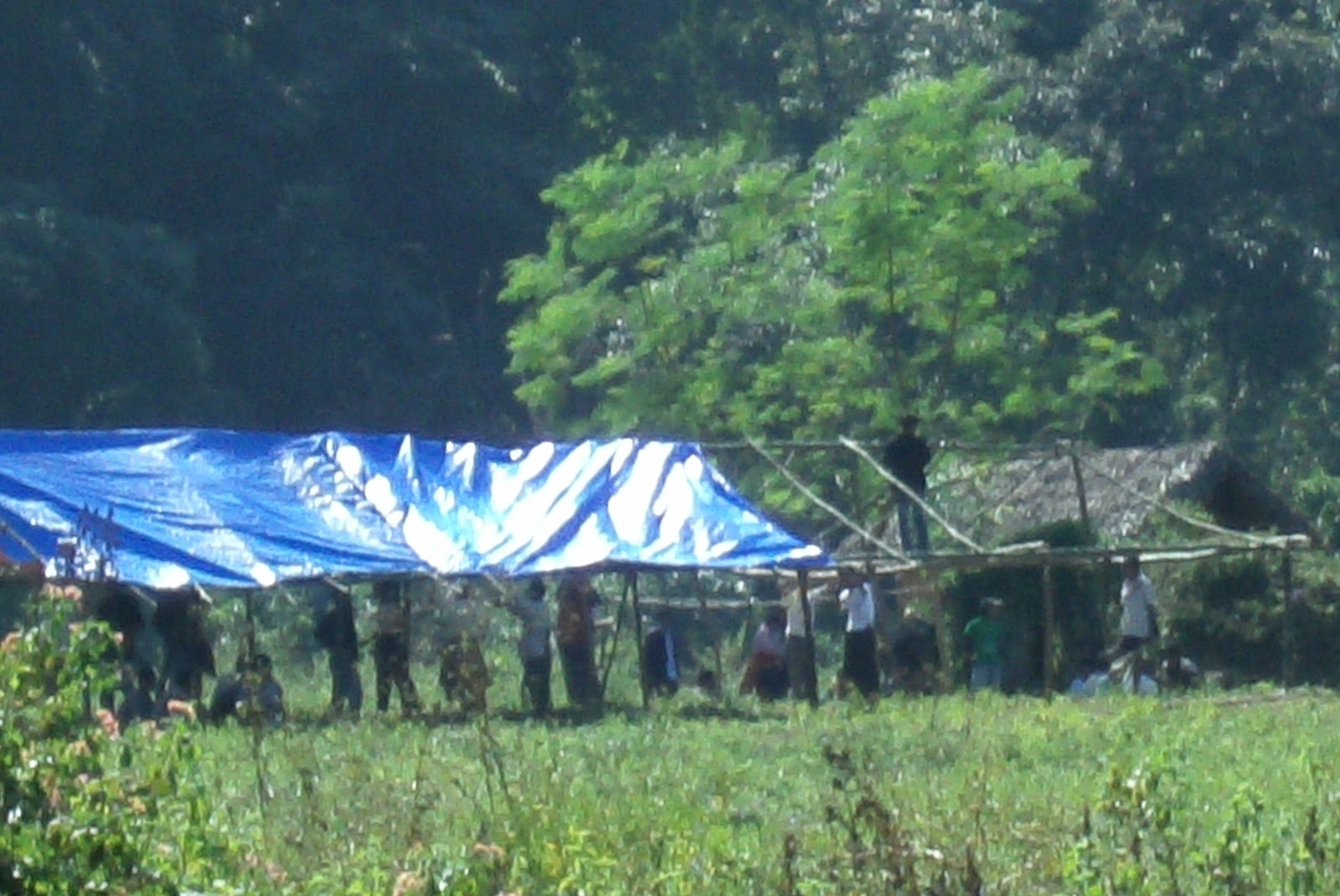
Construction of another house near a Chakma house in progress
Expressing his view in the M-pen land dispute case, David Chakma in his blog (davidchakma.blogspot.in) alleged that it is easy for those who have the backing of political leadership and the bureaucracy to get Land Possession Certificates (LPCs) anytime.

As per information available in the website of the Changlang District, (http://changlang.nic.in/download.html) one can apply for LPC by giving the description of the land for which possession certificate is applied along with supporting documents which includes certificate from the Forest Department, certificate from village council/village headman/ Vice President of Anchal Samity and sketch map of the land in triplicate (not to scale) duly countersigned by the village authority.

The above information suggests that the view expressed by David Chakma cannot be ruled out considering that Ms Thuing Singpho on whose name the LPC was issued by the district administration is close to the political leadership of the state. She is among the richest persons in Miao area and the  extent of influence she has over the local administration is immense. 

Some alleged that there was never any Singpho village in and around the disputed area, therefore question the certificate issued by the village headman/council. This is a valid point raised considering that only the village headman of a particular village who has the knowledge of the land can issue such certificate. Therefore, if the claim of non-existence of any Singpho village in the disputed area is true than someone from other area cannot claim LPC in a different area. It is also alleged that the houses have been built in urgency recently even without waiting for the Court's verdict is to show that the Singphos have been living there since long. 

Further, it is alleged that Ms Thuing Singpho has donated the disputed land to a Singpho Society. The question is can she donate the land in the event of the case being "subjudiced."
At this juncture it is not known who is speaking is truth. Whatever be the status of the land, the case is subjudice and the Court only will determine the status of the land in question. At the same time it is unfortunate that the district administration failed to honour the Court’s order.  

Wednesday, 7 November 2012

ABSU to convene National Seminar on Bodoland issues in New Delhi today


The All Bodo Students Union (ABSU) will convene a National Seminar on issues of Bodoland today at Mavalankar Auditorium, Constitution Club, Rafi Marg, New Delhi. The Seminar, entitled “Conflict in Bodoland, issue of influx and land alienation in Assam: Problems and Perspectives,” is scheduled to commence from 10.30 am to 3 pm.

The day long National Seminar is being organized in the backdrop of the recent riots in the Bodoland Territorial Autonomous Council (BTAD).

A Press invitation of the ABSU reads “The National Seminar is being conducted in view of current volatile situation in Assam due to conflicts, in particular in the Bodo dominated areas. The issue of influx and massive land alienation of the tribals have become burning topic today. The recent conflict in the lower districts of Assam and Bodoland in particular has sparked the flame of fresh mass movement against the illegal influx in the entire state. On the other hand, the question of rehabilitation of the displaced people has become a big challenge for the government of the day. Encompassing all these issues, an inclusive discussion has been felt most necessary to arrive at a rational conclusion of the problems.”

The Seminar, chaired by Prof. Sanjoy Hazarika, Director, Centre for North East Studies at Jamia Millia Islamia, New Delhi, will be inaugurated by G.K. Pillai, former Home Secretary, Government of India and Lt. Gen. S. K. Singha, former Governor of Assam and Jammu and Kashmir will be the Chief Guest. Other speakers include R. N. Ravi (IPS), former Special Director of Intelligence Bureau; Dr. Chandan Mitra, Member of Parliament and Editor-in-Chief of The Pioneer; U. G. Brahma, former Member of Parliament (Rajya Sabha); Suhas Chakma, Director, Asian Centre for Human Rights, Lt. Gen, D. B. Shekatkar; B. G. Varghese, Columnist and Author; Dr Samujjal Bhatacharjya, Adviser, All Assam Students’ Union; Nitin Gokhle Editor Defence, NDTV; Samudra Gupta Kashyap, Senior Journalist, Indian Express; Sanjay Nahar, Founder President, SARHAD, Pune and many other intellectuals.

Wednesday, 24 October 2012

JHPC members to meet in Itanagar for talks on the Chakma-Hajong issues


The much awaited second Joint High Power Committee (JHPC) meeting will be held at Itanagar, Arunachal Pradesh on 26 October 2012. Initially, the JHPC was supposed to hold its second meeting on 11 October. But the meeting was rescheduled due to time-constrain.

The four-party committee, constituted by the Ministry of Home Affairs (MHA) on 10 August 2010 to find a solution to the vexed Chakma-Hajong issue in Arunachal Pradesh, includes the MHA, State Government of Arunachal Pradesh, All Arunachal Pradesh Students’ Union (AAPSU) and the Committee for Citizenship Rights of the Chakmas and Hajongs of Arunachal Pradesh (CCRCHAP).

Shambhu Singh, Joint Secretary (North East), who is also the Chairman of the Committee, and Joint Secretary (Foreigner) will represent the Ministry of Home Affairs. The State Government of Arunachal Pradesh will be represented by R Negi, Commissioner (Home), the Secretary (Political), the Principal Chief Conservator of Forests, K Riram, OSD to the Chief Minister and Deputy Commissioners of Changlang, Papumpare and Lohit. While the Arunachal Pradesh Students Union will be represented by the President, Takam Tatung, Nabam Tamar (Vice-President), Tujum Poyom (General Secretary), T. T. Tara (Legal Adviser) and Toni Pertin (Legal Adviser). The Committee for Citizenship Rights of the Chakmas and Hajongs of Arunachal Pradesh will be represented by Santosh Chakma, General Secretary, Arindam Dewan and three others.

The first meeting of the JHPC was held in January this year. It was mutually decided in the meeting that a joint survey will be conducted by the CCRCHAP and AAPSU to identify the Chakmas and Hajongs who migrated during 1964-69. 

Thursday, 13 September 2012

Principal complies with NCPCR order, Chakma students admitted finally


After days of ignoring the orders of the National Commission for Protection of Child Rights, the principal of a government school in Arunachal Pradesh finally admitted students belonging to the Chakma community in the school.

As per information received by this writer, P Nebang, Principal of Govt. Higher Secondary School, Miao under Changlang district admitted nine Chakma students to Class IXth and Class XI on 13 September 2012. Of these, two students were issued school leaving certificates (SLCs) and forced to move out last month along with another six students. The Miao school has 15 Chakma students now. 

The Chakma students have been allowed in the school only after unrelenting interventions by the National Commission for Protection of Child Rights. The apex child rights body has issued a number of directions to the state authorities to admit Chakma students in the school. But, the orders were ignored, forcing the NCPCR to issue a fresh order to the principal to readmit the students.

This writer was also informed that the admitted Chakma have been asked to deposit CBSE registration fee.

It is pertinent to mention that more than 80 Chakma students were denied admission last year on the ground that the students approached for admission late, as a result of which, permission of the CBSE for late registration could not be obtained. This is an excuse as the students had approached the schools since start of the admission process.

Saturday, 8 September 2012

Principal declines to readmit Chakma students


By Tejang Chakma

In a complete defiance of order of the apex child rights body, the Principal of Govt. Higher Secondary School, Miao in Changlang district of Arunachal Pradesh refused to readmit the Chakma students. Eight Chakma students who were given admission at the school were issued transfer certificates last month. The students were asked to take admission in a newly upgraded secondary school in another administrative circle, which has neither infrastructure nor teaching staff.

Recently, the National Commission for Protection of Child Rights asked the state government to direct the Principal to take back the students in the school. On 7 September 2012, the eight students met the Principal but of no avail. The Principal categorically told them that they will not be readmitted.

This writer has learned that the school authorities of newly upgraded secondary school, where the students have been asked to proceed, also decided not to admit them.

The CBSE registration will also start shortly. Once the registration is done, these students will lose one precious academic year.

The National Commission for Protection of Child Rights is now the only ray of hope for these students. 

Friday, 24 August 2012

Educational deprivation


Last year, eighty-eight students belonging to the Chakma community of Arunachal Pradesh had suffered one academic lost due to denial of admission in secondary schools. These poor and hapless students did not get admission despite interventions of the National Human Rights Commission and National Commission for Protection of Child Rights. The interventions by the National Human Rights Institutions had little impact due to willful non-compliance of the orders. The state government did not submit reports despite reminders issued by the Commissions. Finally, when the reports were submitted it had no relevance as by then the school academic session was well over.

The recent direction of the National Human Rights Commission (NHRC) makes the picture clearer. Taking cognizance of a complaint filed by Asian Centre for Human Rights, the NHRC asked the state government to submit report, within two weeks, regarding denial of admission to the Chakma students to secondary school. No report was forthcoming despite reminders. It takes a final reminder on 28 February 2012 to get the state government moving. Yet, it took almost two months to submit reports. In a letter dated 18 April 2012, the Commissioner & Secretary (Education), Government of Arunachal Pradesh, Itanagar has forwarded reports obtained from various authorities of the State Education Department.

But the reports submitted are not legible. In its latest proceedings the NHRC noted “The Commission perused the reports which are very dim and not legible.” This left the Commission with the only option to ask for clear and legible reports. Accordingly, the Commissioner & Secretary (Education), was directed to send clear and legible copies of the reports within six weeks. The time given has no value now as the students lost a year.

The story was written in advance by the state government and the NHRC was made to do what it wanted. Yet, another delay. The delay is not hard to understand. It was deliberate and has two reasons.

First, the state government has no answers for the academic loss of the students. So, illegible reports were purposely submitted to further the delay.

Second, the Chakmas are not recognized as citizens and not treated equally. They are kept out of government scheme. The state does not want to see the development of the Chakma community. Education is a key to development of any society. Now, the denial of education opportunity has become a tool to keep the Chakmas in dark.

Nothing will compensate the loss suffered by the students. Their future has been destroyed. This is not one off case. Many Chakma children are silently dropping out due to lack of access to schools over the years. They have only one option left to get married early and become parents of multiple of children. Yet, the state complained that the population of the state is increasing due to influx from states like Mizoram and Tripura.

The question is whether the Chakmas of Mizoram, where they have their own autonomous district council, and Tripura, where the Chakmas have all opportunities including education and employment, will come to Arunachal Pradesh to live in destitution.

Thursday, 23 August 2012

Principal forcefully removes Chakma students from school


By Tejang Chakma

IN A shocking move, the principal of a government school has forcibly removed six students in Changlang district of Arunachal Pradesh on 21 August 2012. The students were asked to collect their school leaving certificates and leave the school forthwith while they were attending a class.

On August 21, the six students, as usual, went to school clueless that the day would be their last day in the school. The 9th standard students of the Government Higher Secondary School, Miao in Changlang district belong to the Chakma community. This is the first time the school had admitted Chakma students since 1995, made possible only following interventions by the National Commission for Protection of Child Rights (NCPCR).

As per information received by this citizen journalist, P Nebang, Principal of the school, directed the students to leave the school as their presence in the school 'may invite physical attacks on them by students of other communities'. The Principal while directing them to collect their school leaving certificate (SLCs) asked them to take admission at a school in a different administrative circle. The students, having no option, left the school but did not collect the SLCs.

Prior to this shocking decision of the Principal, the Additional Deputy Commissioner (ADC), Miao in a letter dated on 17 August 2012 summoned the guardians of the six Chakma students to his office to discuss the admission issue of their wards. As directed, the guardians of the six students met the ADC, Miao on 21 August. The ADC, Miao informed them that the Chakma students cannot be allowed to study in the school due to opposition by the local communities and that there was   a likelihood of violence against them by other students if they continue to attend classes. The ADC further stated that if the Chakma students are harmed he will not be able to save them as it will take at least hours to reach them and to provide police protection. He will not be responsible for any untoward incidents against them and therefore he will not allow the Chakma students to continue in the school.

When the guardians requested the ADC to at least allow their wards to study for this session, he stated that “if they are allowed to continue studies it will be difficult to get them leave the school later”.

It is important to mention here that the Chakma students never complained of any harassment by other students who treated them well since they were admitted in the school. It is alleged that these students were removed from the school due to ethnic origin. The school authorities and the administration allegedly do not want any Chakma students to study in this school. This school is the only secondary level school in the Miao circle.

This citizen journalist has further learnt that eight Chakma students were removed from the school on 13 August on the same ground. Pursuant to interventions of NCPCR a total of 14 Chakma students were admitted in the school. These students are yet to get admission and are on the verge of losing a precious academic year.

The school where the Chakma students were asked to take admission is a middle school, which has been recently upgraded to secondary level, is far from their villages and there is no infrastructure including teaching staff. The school is upgraded only on paper.

Published in Merinews.com, 23 August 2012